
Tree and palm removal across Fort Lauderdale
Tree Removal in Fort Lauderdale, FL
Palms, storm-damaged trees and trees that have outgrown their spot, taken down around pool cages, tile roofs and seawalls with the city permit question settled first.
- No-cost estimates at your property in Fort Lauderdale and nearby towns
- Your quote, in writing, itemized by tree
- Cleanup plan agreed before work starts
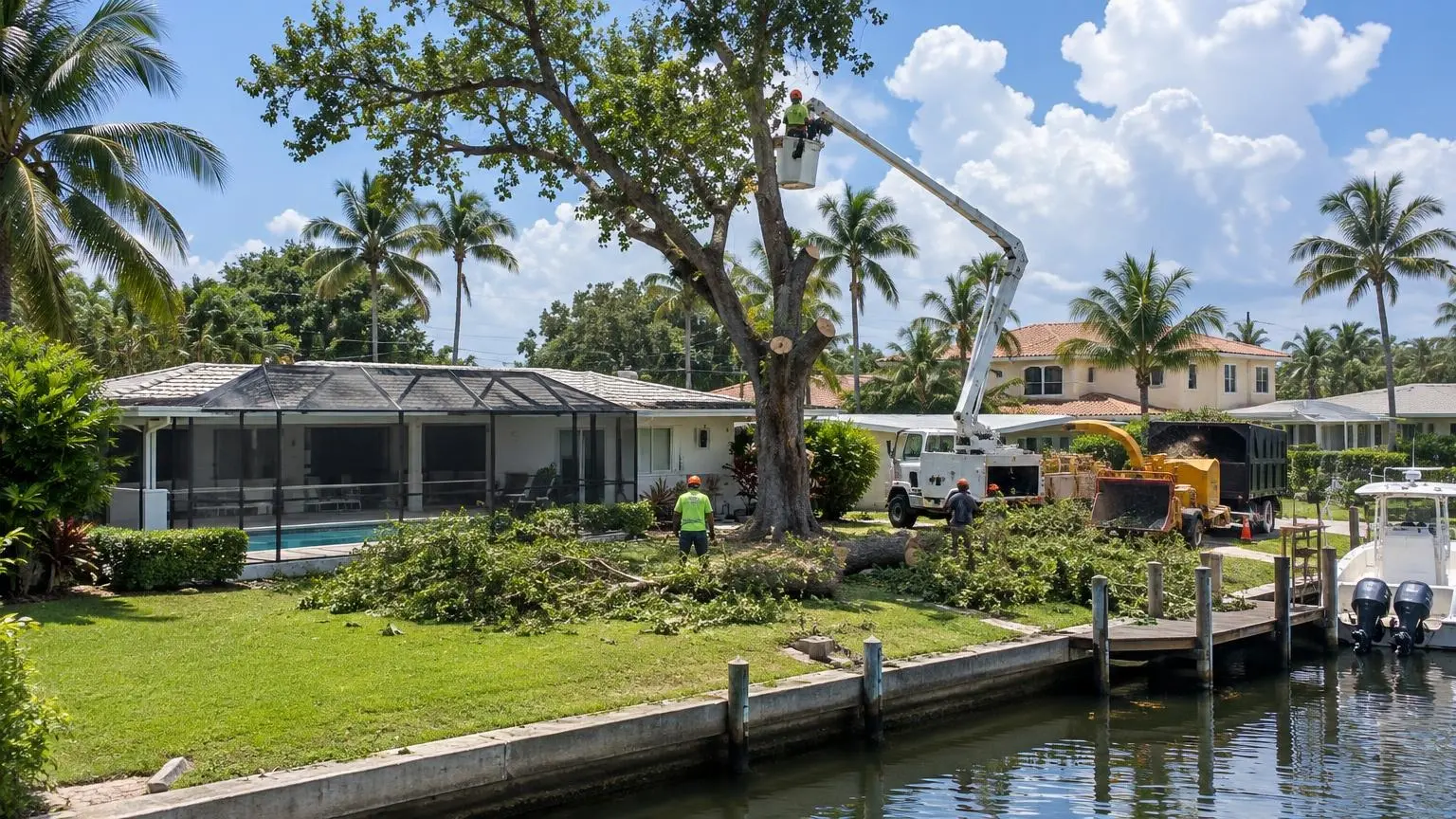
Removing Trees in a City Built on Sand, Canals and Hurricanes
Tree removal in Fort Lauderdale is shaped by three things you don't deal with in most of the country: hurricanes, a water table close to the surface, and lots squeezed between a house and a canal. The city sits about seven feet above sea level and has some 165 miles of canals and inland waterways. Trees here grow fast in heat and roughly 61 inches of rain a year, then meet a storm season that runs from June through November. A tree that looks healthy in March can be on a roof by October, and a palm that looks green from the street can already be dying from the crown down.
Why storms knock trees over here
When the water table is high, roots stay in the top layer of soil. University of Florida researchers note that trees on wet sites never develop the deep sinker roots that anchor them, so as they grow larger they become prone to tipping over, and they are especially vulnerable when construction digs into the ground around them. Hurricane Wilma crossed Broward County on October 24, 2005; the National Weather Service recorded a 99 mph gust in Fort Lauderdale that morning and described large trees and power lines down virtually everywhere in South Florida. That pattern of whole trees uprooted, not just limbs broken, is why we look closely at roots, soil and lean, not only at the canopy.
Which trees cause the most trouble
UF/IFAS studies of hurricane damage rank species by how well they stand up to wind. Live oak, gumbo limbo and sabal palm rank highest. Sea grape, mahogany, royal palm and coconut palm do reasonably well. Black olive, laurel oak and strangler fig rank lower, and Australian pine, weeping fig (Ficus benjamina), queen palm, Washington palm and Norfolk Island pine are among the weakest. Common removal requests in Fort Lauderdale involve big black olives and ficus planted decades ago on small lots, tall queen and Washington palms over roofs, and Australian pines along canals.
Lethal bronzing in palms
Lethal bronzing is a bacterial disease spread by sap-feeding insects, and UF/IFAS lists Broward County among the Florida counties where it has been confirmed. It attacks cabbage (sabal) palms, coconut palms, date palms and queen palms, among others. Fruit drops early, older fronds discolor first, and when the spear leaf at the very center collapses, the bud is dead. There is no cure once symptoms show; UF/IFAS advises removing an infected palm right away, testing palms close to it and protecting healthy ones with antibiotic injections. A dead palm head can drop without warning, so these removals should not wait for the next storm.
Permits come first
Fort Lauderdale's landscape and tree preservation rules require a tree removal permit for many trees on developed single-family lots: trees with a trunk diameter of eight inches or more, and coconut, royal and date palms with eight feet or more of trunk. Australian pine, Brazilian pepper and melaleuca can be removed without a permit or replacement. Under Florida Statute 163.045, a city also cannot require a permit, fee or replacement tree when the owner of a single-family home has a signed assessment from an ISA Certified Arborist or Florida licensed landscape architect showing the tree is an unacceptable risk. We sort out which rule applies before we quote a start date.
Tree Removal and Related Work
Six services cover nearly every tree problem on a Fort Lauderdale property, from one dying coconut palm to a ficus that has outgrown the whole backyard.
Tree Removal
Black olives, ficus, oaks and other hardwoods taken down in sections around houses, pool cages and canals, permit checked first.
Learn more →Palm Tree Removal
Dead, dying and unwanted palms removed, including coconut, royal, queen and date palms lost to lethal bronzing.
Learn more →Emergency Storm Tree Removal
Trees on roofs, cars, pool cages and driveways after hurricanes and summer squalls, handled in order of danger.
Learn more →Dead & Hazard Tree Removal
Dead, rotting, cracked and leaning trees taken down before they fail, with the state's risk-assessment rule explained.
Learn more →Tree Trimming & Pruning
Structural pruning, canopy thinning and clearance cuts done to national standards, with an eye on hurricane season.
Learn more →Stump Grinding
Hardwood and palm stumps ground below grade so the spot can be replanted, sodded or paved.
Learn more →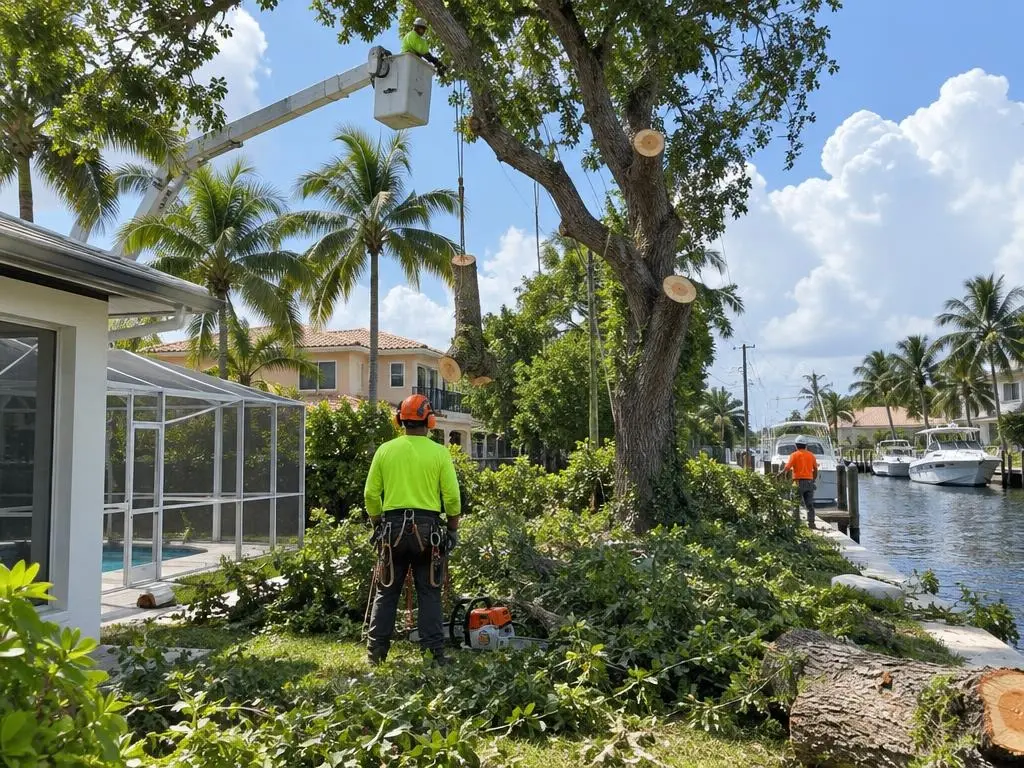
Why Homeowners Call Tree Removal Fort Lauderdale
Permit question answered first
We tell you whether the city requires a permit, whether the tree is an exempt invasive species, or whether a risk assessment under state law applies, before a date is set.
Pool cages, tile roofs and seawalls planned for
Limbs and trunk sections over a screen enclosure, roof or dock are rigged and lowered. The plan for protecting each one is part of the quote.
Palms judged by the crown
We look at the spear leaf, the fronds and any fruit drop for signs of lethal bronzing, and tell you when a palm can be saved and when it cannot.
One price on paper
The written quote covers the tree, the stump, the cleanup and the haul-away. If something changes, you see the change in writing before we do it.
Common Questions
Do I need a permit to remove a tree in Fort Lauderdale?
Often, yes. On a developed single-family lot the city requires a tree removal permit for trees with a trunk diameter of eight inches or more and for coconut, royal and date palms with eight feet or more of trunk. Some invasive species, including Australian pine, Brazilian pepper and melaleuca, need no permit. If a tree has been documented as an unacceptable risk by an ISA Certified Arborist or a licensed landscape architect, Florida law says no city permit is required.
How much does tree removal cost in Fort Lauderdale?
National cost guides put most residential removals between about $200 and $2,000, with an average around $750 to $850. Palms usually cost less than hardwoods of the same height; Angi's 2026 figures average about $525 for a palm. Over a pool cage, a roof or a seawall, the price goes up because pieces have to be lowered. Your written estimate after the site visit is the price.
Do I need a permit just to trim a tree?
No. The City of Fort Lauderdale does not require a permit to prune a tree, but pruning has to follow national pruning standards. Flat-cutting the top off a tree, called hatracking, is defined in the city's tree code as tree abuse.
Who handles a tree touching a power line?
Florida Power & Light. FPL says only specially trained line-clearing crews should work near its lines, and that everyone else should stay at least 10 feet from neighborhood lines. Call FPL at 1-800-226-3545 or report it at FPL.com/trees, and we can work on the rest of the tree once the line is clear.
My palm's center leaf turned brown. Can it be saved?
If the spear leaf has collapsed, the bud is usually dead and the palm will not recover. In Broward County, lethal bronzing is a common cause; UF/IFAS says infected palms should be removed promptly because there is no cure once symptoms appear. Nearby palms of the same type can be tested and protected with preventive injections.
Will the city pick up the branches if I cut them myself?
Small amounts, yes. Fort Lauderdale collects yard waste weekly, and limbs can be up to 12 feet long and 12 inches thick. Bigger piles go out with monthly bulk pickup, limited to 10 cubic yards, and the city does not take stumps. Debris from a hired tree company is normally hauled away by that company, and our quotes say so in writing.
Is there a tree removal company near me in western Broward?
We work across central Broward, including Plantation, Davie, Lauderhill and Tamarac as well as Fort Lauderdale itself. Call or send the form with your address and we will tell you whether it falls inside our area before setting up the estimate.
The Area We Cover
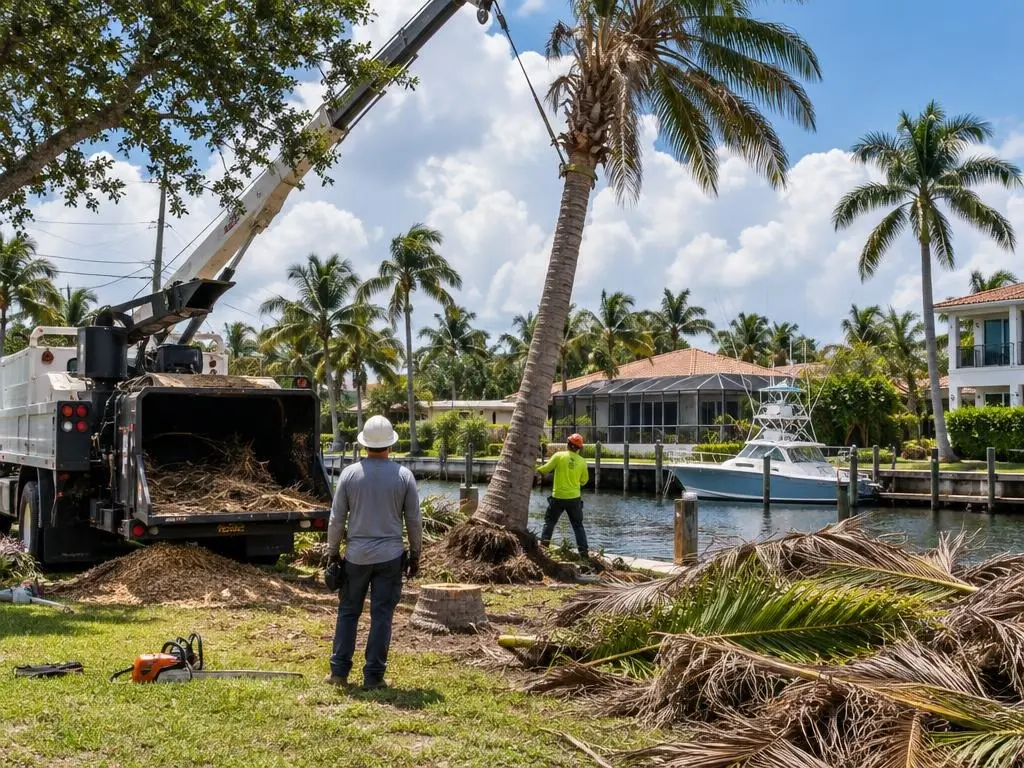
Fort Lauderdale is the center of our service area, from the beachfront and the Las Olas isles to Rio Vista, Colee Hammock, Victoria Park, Coral Ridge and the western neighborhoods along I-95. Around it we work in Wilton Manors, Oakland Park, Lauderdale-by-the-Sea, Lauderdale Lakes, Lauderhill, Plantation, Davie, Dania Beach, Hollywood and Tamarac. Each city in Broward writes its own tree rules, so a palm that needs a permit in Fort Lauderdale may follow a different process two miles away; we check the rules for the address on the quote. Waterfront lots on the isles bring seawalls and docks into the plan, older inland neighborhoods tend to have big black olives and ficus near small houses, and newer western subdivisions often have HOA rules on what can be removed and what must be replanted.
- Tree Removal in Fort Lauderdale, FL
- Tree Removal in Hollywood, FL
- Tree Removal in Pembroke Pines, FL
- Tree Removal in Miramar, FL
- Tree Removal in Coral Springs, FL
- Tree Removal in Davie, FL
- Tree Removal in Plantation, FL
- Tree Removal in Sunrise, FL
- Tree Removal in Pompano Beach, FL
- Tree Removal in Deerfield Beach, FL
- Tree Removal in Weston, FL
- Tree Removal in Lauderhill, FL
- Tree Removal in Tamarac, FL
- Tree Removal in Margate, FL
- Tree Removal in Coconut Creek, FL
- Tree Removal in Cooper City, FL
- Tree Removal in Dania Beach, FL
- Tree Removal in Hallandale Beach, FL
- Tree Removal in Oakland Park, FL
- Tree Removal in Wilton Manors, FL
- Tree Removal in Lighthouse Point, FL
- Tree Removal in Parkland, FL
- Tree Removal in Southwest Ranches, FL
- Tree Removal in Lauderdale-by-the-Sea, FL
- Tree Removal in North Lauderdale, FL
Schedule a Free Tree Visit
Free on-site estimates in Fort Lauderdale and across central Broward County.