
Laid out by Morris Lapidus on a blank slate
Tree Removal in North Lauderdale, FL
Removing the big trees that grew up with North Lauderdale's 1970s neighborhoods.
- No-cost estimates at your property in Fort Lauderdale and nearby towns
- Your quote, in writing, itemized by tree
- Cleanup plan agreed before work starts
A 1970s City Whose Trees Have Caught Up
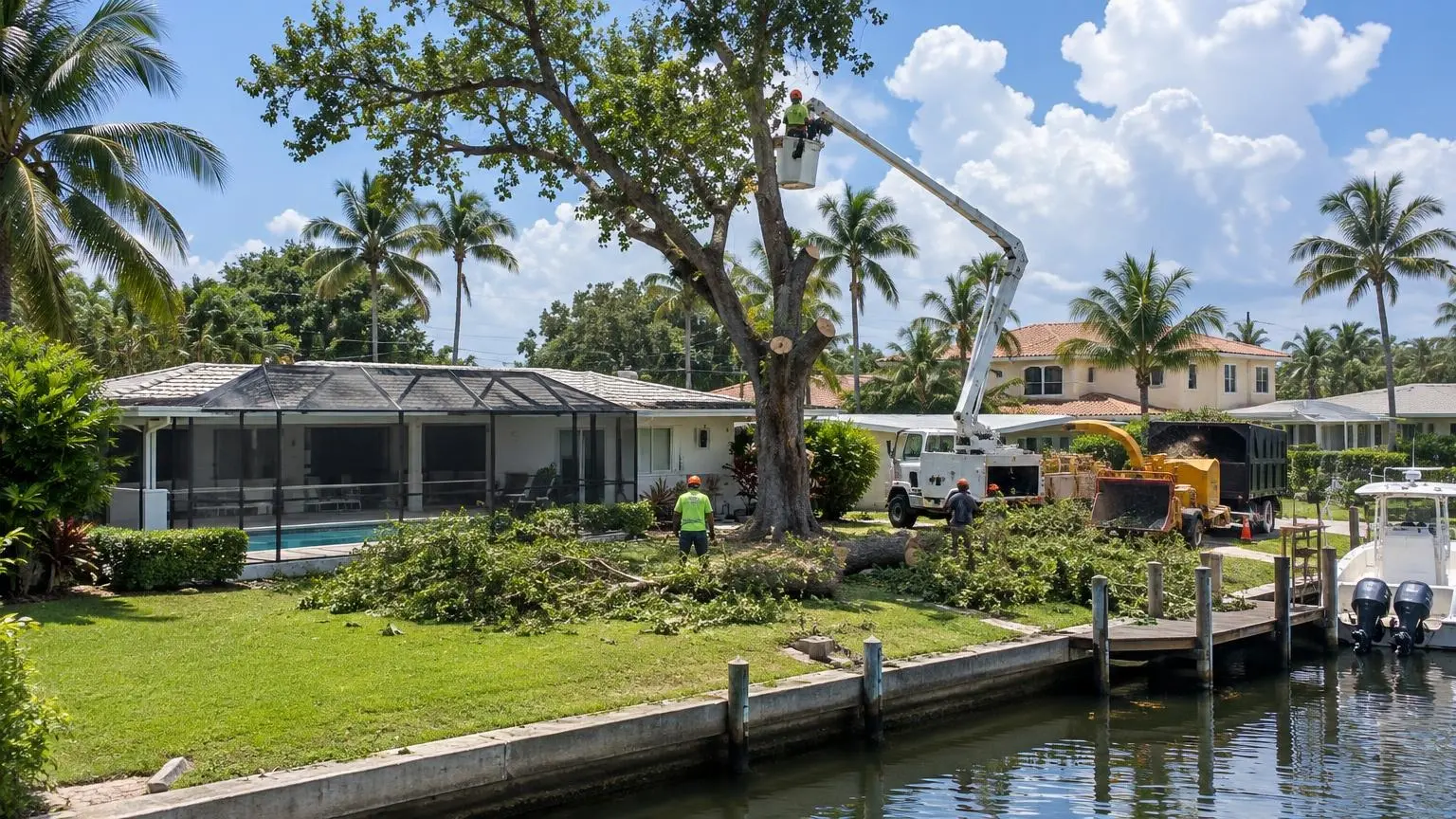
Tree Removal in North Lauderdale is mostly about trees planted during one decade. Before the city incorporated in 1963, its land was pasture and farmland, including the Anderson Dairy Farm and the Lena Lyons Stringbean Farm. The Osias Organization, led by Colonel Nathan Rood, bought most of it in the late 1960s, and a building boom of about ten years through the 1970s brought in many single-family homes. The population went from 1,213 in 1970 to 18,653 in 1980.
50-year-old trees, 50-year-old houses
Those 1970s yards were planted all at once, and the trees have now had about 50 years to grow. That's long enough for a shade tree to be wider than the house, for roots to reach the slab, driveway and sewer lateral, and for internal decay to start where old limbs were cut badly. Many of the removals we do here are trees that the homeowner inherited with the house and that were too close to it from the start.
A designer city
Architect Morris Lapidus, best known for Miami Beach hotels, laid out North Lauderdale and called it a rare chance to work with a blank slate. His plan includes the amoeba-shaped Boulevard of Champions and whimsical "beacons" around the city. It's a compact place, about 4.6 square miles, with 44,794 residents and 14,920 housing units at the 2020 census. Lots are small, so almost every removal is done in sections.
Storm exposure
After Hurricane Wilma in October 2005, an aerial survey found that about 70% of homes and businesses in North Lauderdale and five nearby cities had some degree of damage. The city sits about 10 feet above sea level and has a tropical rainforest climate bordering on tropical monsoon, with frequent summer downpours. Heavy, mature crowns on 1970s-planted trees are the ones most likely to break in the next big storm.
What North Lauderdale homeowners ask for
- Removing oversized trees over roofs and carports
- Taking out trees whose roots are cracking driveways and plumbing
- Removing palms leaning over pools and fences
- Storm cleanup and hazardous limb removal
- Stump and surface-root grinding before new sod or pavers
A smarter replacement
When the old tree comes out, think about the next one. FPL recommends medium trees, which top out between 14 and 49 feet, be planted at least 30 feet from power lines, and large trees of 50 feet or more at least 50 feet away. Small trees under 14 feet can go right next to the lines. On North Lauderdale's compact lots, that usually points to a small or medium native planted well away from the house, rather than another large shade tree that will cause the same problems in 2075.
Permits
Check with the city before removing a tree. If the tree is a hazard on a single-family lot, Florida Statute 163.045 lets the owner skip the local permit, fee and replanting requirement with a signed risk assessment from an ISA-certified arborist or Florida-licensed landscape architect. Call (954) 314-3415 or send the form for a free estimate. Get a free estimate
North Lauderdale Facts
- 1970s building boom. A roughly ten-year building boom in the 1970s brought many single-family homes; the population grew from 1,213 in 1970 to 18,653 in 1980.
- Farm origins. Before incorporation on July 10, 1963, the land was pasture and farmland, including the Anderson Dairy Farm and the Lena Lyons Stringbean Farm.
- Lapidus plan. Architect Morris Lapidus laid out the city, including the amoeba-shaped Boulevard of Champions; the city had 14,920 housing units in 2020.
- Wilma damage. After Hurricane Wilma in 2005, about 70% of homes and businesses in North Lauderdale and five nearby cities showed some degree of damage in an aerial survey.
Our Services in North Lauderdale, FL
North Lauderdale Questions
Is it worth removing a healthy tree that's too close to my house?
Often, yes, if it's lifting the slab or crowding the roof. A tree planted too close in the 1970s will keep getting bigger. Removing it now costs less than repairing a foundation or roof later.
Can you grind out the roots under my driveway?
We grind the stump and major surface roots near the driveway so a paver or concrete contractor can repair it. Roots directly under the slab are left for the driveway contractor to cut when the slab comes up.
Do you remove trees in North Lauderdale's smaller lots?
Yes. Nearly every job here is a sectional removal, with limbs lowered by rope into the yard.
Can you remove a tree and grind the stump in the same visit?
Usually, yes. Most North Lauderdale removals include the stump grind on the same day, so the yard is ready for sod or a new tree.
Free Estimates in North Lauderdale, FL
Free estimates across North Lauderdale.
Tree Removal Near North Lauderdale
- Tree Removal in Fort Lauderdale, FL
- Tree Removal in Hollywood, FL
- Tree Removal in Pembroke Pines, FL
- Tree Removal in Miramar, FL
- Tree Removal in Coral Springs, FL
- Tree Removal in Davie, FL
- Tree Removal in Plantation, FL
- Tree Removal in Sunrise, FL
- Tree Removal in Pompano Beach, FL
- Tree Removal in Deerfield Beach, FL
- Tree Removal in Weston, FL
- Tree Removal in Lauderhill, FL
- Tree Removal in Tamarac, FL
- Tree Removal in Margate, FL
- Tree Removal in Coconut Creek, FL
- Tree Removal in Cooper City, FL
- Tree Removal in Dania Beach, FL
- Tree Removal in Hallandale Beach, FL
- Tree Removal in Oakland Park, FL
- Tree Removal in Wilton Manors, FL
- Tree Removal in Lighthouse Point, FL
- Tree Removal in Parkland, FL
- Tree Removal in Southwest Ranches, FL
- Tree Removal in Lauderdale-by-the-Sea, FL